Audio commentary at Sparta is our priority (full text from Sparta’s club magazine)
In our interview with blind fan Filip Kunc you read that Sparta is the only club in Czechia that regularly provides audio commentary of its home matches, so that visually impaired fans can also enjoy the games at Letná. One of the commentators is Štěpán Hájek, who told us more about his work.
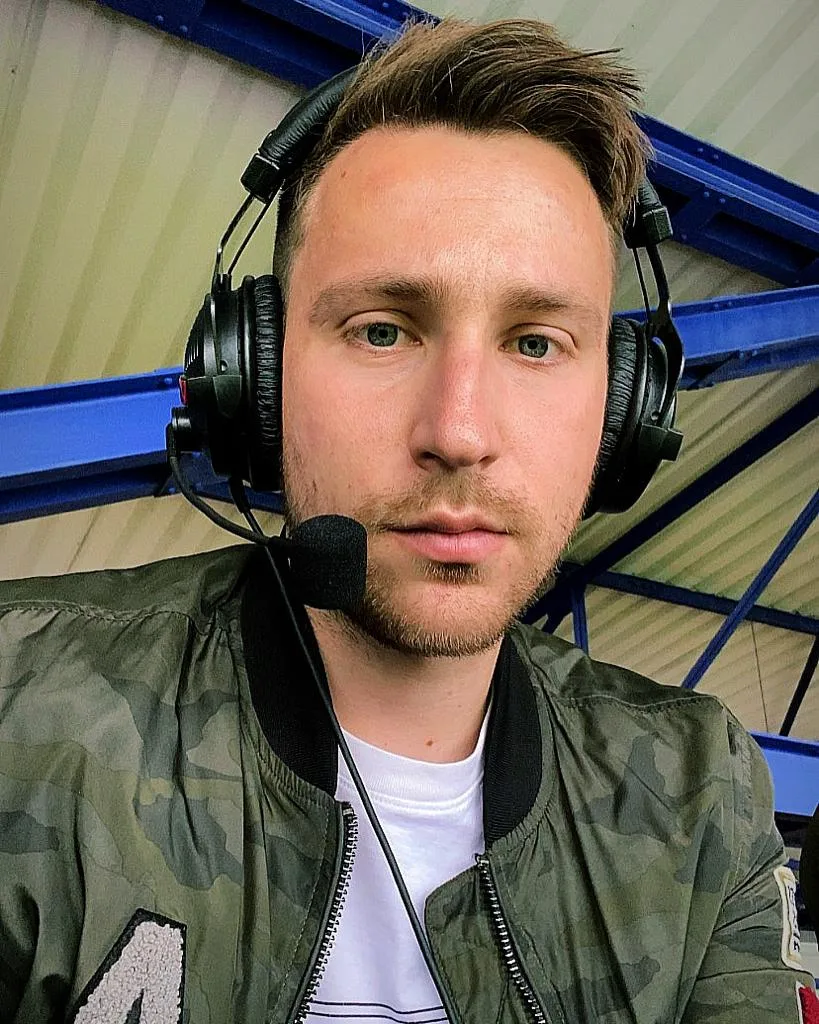
Štěpán Hájek works for an agency that has an agreement with Sparta to provide two commentators for every home match, commentating both for blind fans directly at the Generali Česká pojišťovna Arena and for Sparta’s website at live.sparta.cz. “It also depends on the arrangement. During covid, for example, we couldn’t be here because of the limited capacity, and for the match against Trabzonspor we commentated from the studio. Normally, though, we are at Letná, where we have our seats in the press box on the main stand. Audio commentary is quite an interesting alternative for someone who can’t watch the game on TV and isn’t at the stadium either. And since we are Sparta fans, there is added value, because people don’t have to listen to a neutral commentary on other platforms.”
Six commentators take turns at Sparta’s home matches. “At the agency we have a team of, let’s say, more experienced commentators who come here so that the commentary has a certain quality and level. The fact that we are Sparta fans may also have played a role in the selection. In the wider group there are more than twenty of us, so it really is a selection. And since home matches are usually played once every two weeks, there can’t be too many of us, so that we get used to how the equipment is set up and how it all works.”
The commentators change for every match so that it isn’t always the same people. “We rotate, because of course everyone wants to come here, it’s right at the stadium. Normally we commentate from the studio, so this is a welcome chance to try it out in the field, which feels more authentic. That’s why there’s a bit of competition for it, but we rotate according to who has been here how many times and who was here last. It also depends on people’s availability. Most of us are active footballers, so it can clash with a match or other work.”
Štěpán currently plays in the Czech third division for Hostouň, but in the past he was also at Sparta, where he achieved what most footballers dream of. “I came to Sparta at 16 from Motorlet Prague. Through the youth teams and the juniors I made it to the B team, which was coached by Hašek and Horňák at the time. In the summer league cup back then I even made one appearance for the first team, an experience I will probably never forget. I have very fond memories of my time at Sparta, both football-wise and personally. I’m still in touch with many of the players, coaches and club staff.”
The commentators arrive at Letná an hour before kick-off and prepare their equipment. “That includes setting up and connecting the laptop, headphones, microphones, the internet cable, the audio box, which is the device that carries the signal, and the application the commentary runs through. Then we check the frequencies, the transmitter, the headphones and the software settings of the microphones. It may sound more complicated than it really is, but for us it’s routine by now.” The whole process takes 15 to 20 minutes if everything is in order. “With colleagues in the studio we test whether everything is running and set up correctly. We tune the echo, because we can still adjust it on our audio box. There I can turn the sound down and adjust it in various ways so that listeners can enjoy the most comfortable listening possible. Just to be sure, we check everything at least twice.”
The commentators sit next to each other in the press box and start the broadcast after Sparta’s anthem, just before kick-off. “We start the classic way, with an opening monologue, a welcome, the line-ups, the referees, general statistics and the head to head. During the match we take turns roughly every five minutes. We hear each other through talkback, which lets us communicate. There is a kind of dialogue between us so that it is more interesting for listeners and not a monotonous narration by one of us. We hand over by me lowering the intonation of my voice or by recapping the score, the minute or the situation, which are signals for my colleague to get ready. I think we are well attuned and it works well.”
The broadcast is interrupted at half-time, which they use for refreshments and preparation. “We stay in our seats, watch the substitutes and check communication with the studio support, who would message us if something wasn’t right, if anything sounded disturbing or if someone said something nonsensical. So we have that kind of support too, and it helps us a lot.” The broadcast ends with the commentators signing off. “We usually stay for the players’ thank-you to the fans, because we’re interested and something can happen there that we can use as material for the next match. Then we pack up the equipment, which is a much quicker process after the match than before it. It takes about five minutes and we head home.”
So how does a commentator prepare for a match? “The work itself is similar to TV commentary, but of course it has to be more descriptive, because we take into account that the listener can’t see what is happening on the pitch, and we have to convey an authentic experience so that the fan can picture it. Sometimes we add interesting facts so that it isn’t monotonous and purely descriptive. I think it’s quite similar to how TV commentators prepare. We collect various interesting facts and details about the players. One of the first pieces of feedback we got at Sparta was that blind fans are interested in things like the colour of the boots, the players’ looks and so on. We understand that their imagination works differently, so we try to bring it to life. We look at what boots or haircut a player has had and, say, which kits were worn in the previous match.”
To find information for the commentary they use the usual statistics websites, Sparta’s website and images on Google. The difference comes with finding out how to pronounce players’ names. “That is often quite a puzzle. Although we know the names of the league players well, every now and then a new player appears and we are not one hundred percent sure. YouTube helps then: we specifically look for a video where the player introduces himself by name, or where commentators have already said his name. The Premier League can be an inspiration here, as it made short videos in which all players clearly introduce themselves with their full names, so you don’t have to do that research.”
To keep the audio commentary at the highest possible level, the commentators regularly receive feedback from their superiors at the company. “It’s once every six months to a year, when they tell us what to improve, what to focus on, and things like voice intonation, vocabulary or emotions, whether there are too few or too many. It’s a comprehensive review we get once a season, based on listening to us over a certain period or at random. That also decides, on quality, who goes to Sparta and who doesn’t. At the moment this project is our priority.”
Source: https://magazin.sparta.cz/sparta-do-toho-29-kolo-1-fc-slov-cko/